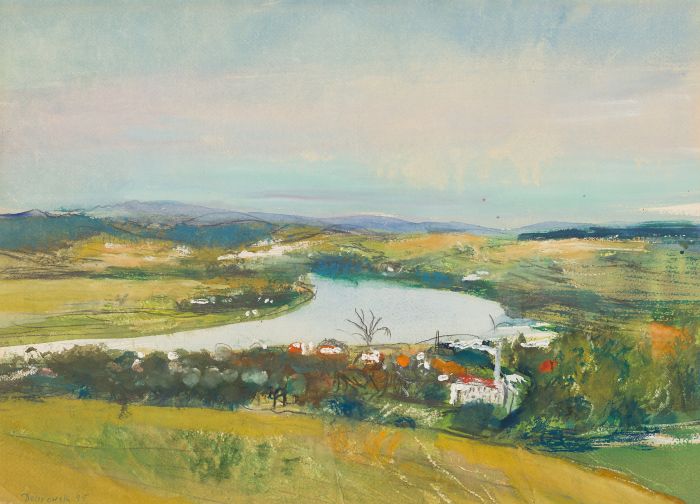
Oil on canvas;
Monogrammed and dated top right;
27.56 × 20.08 in inch framed;
The German painter and graphic artist Ulrich Güssow (1907–1949) is regarded as a subtle representative of the New Objectivity movement. He began his academic training in 1926 at the State Academy of Fine Arts in Weimar under Alexander Olbricht. After a period of artistic activity in Berlin, he returned to Weimar in 1929 to continue his studies under Walter Klemm. A year-long stay in Italy between 1933 and 1934 had a lasting impact on his visual sensibility. From 1935 onwards, Güssow chose the university town of Jena as his permanent base for life and work.
His relatively small surviving oeuvre focuses primarily on portraits, studies of women, and nudes, among which the expressive Portrait of Franziska Lohmann stands out as a key work. Stylistically, these works are characterized by clear, precise contours and a distinctly objective, detached pictorial composition. Following his early death in 1949, his watercolors and paintings have only occasionally appeared on the art market.